

1
Identify the claim being checked
Write down what the finding asserts: the subject, action or relationship, place and time. Separate a source’s report from an agent’s inference.For your task, check the strength of the claim against what the source actually states. A report that an event occurred does not by itself establish its cause or intent.
2
Open the cited source version
Select the citation or evidence reference. Check the source identity, cited content version and locator, then inspect the passage, record, frame, observation or geometry it identifies. Read enough surrounding content to check qualifications and context.A citation addresses one exact version. If a newer version exists, inspect it separately; it does not replace the evidence behind the earlier finding. Record a correction as a change to the assessment with its own evidence.Check event time against publication or collection time. Missing time remains unknown. A document’s publication date alone does not date the event it describes.
3
Check derived evidence when relevant
For an entity, relationship or attribute, open its supporting mentions and citations. Follow the evidence through the producing enrichment result to the exact source fragment version.Check whether the value was reported by the source or inferred during extraction. Inspect processing coverage and outcome: no extracted mentions, unsupported input, partial processing and failure have different meanings.Entity status, mention counts and confidence scores do not establish that a claim is true. Two analyses of one item count as one observation. Multiple sources may share an origin; counts alone do not prove independent corroboration. Keep conflicting attribute values visible until the evidence resolves them.
4
Compare support, contradiction and gaps
Inspect contrary accounts within the same scope and period. Compare what each source actually says, which versions were used and whether the accounts describe the same event.Ask Explorer to distinguish direct support, inference and unresolved conflict. Verify its answer against the cited inputs. An explanation without enough support remains a hypothesis; an inaccessible source does not become evidence against it.Check the workspace’s collection coverage and processing state. Missing access, an excluded dataset, unfinished processing or an unsupported input can limit the finding. An empty search result alone does not establish that no event occurred.
5
Handle unavailable or expired evidence
If a reference cannot open, record the source/version identity and the reason shown. Distinguish lost access from removed or expired content. Ask an authorised owner to resolve an access issue; do not substitute another version silently.A citation alone takes no retention hold. Temporary stream inputs can expire. A retained output requires preservation of its complete effective input set before expiry; visible citations may show only a subset of what the operation consumed.Treat a finding whose material support cannot be inspected as limited. Do not describe it as verified until the necessary evidence is available and checked.
6
Record the inspection outcome
Update the investigation or save a new artefact version with the checked claim, exact evidence references, relevant dates, conflicting accounts and material limitations.Confirm that another authorised reader can open the cited versions and required assets. Creating a revised version preserves the earlier record and requires fresh review if the revised output is to be published.
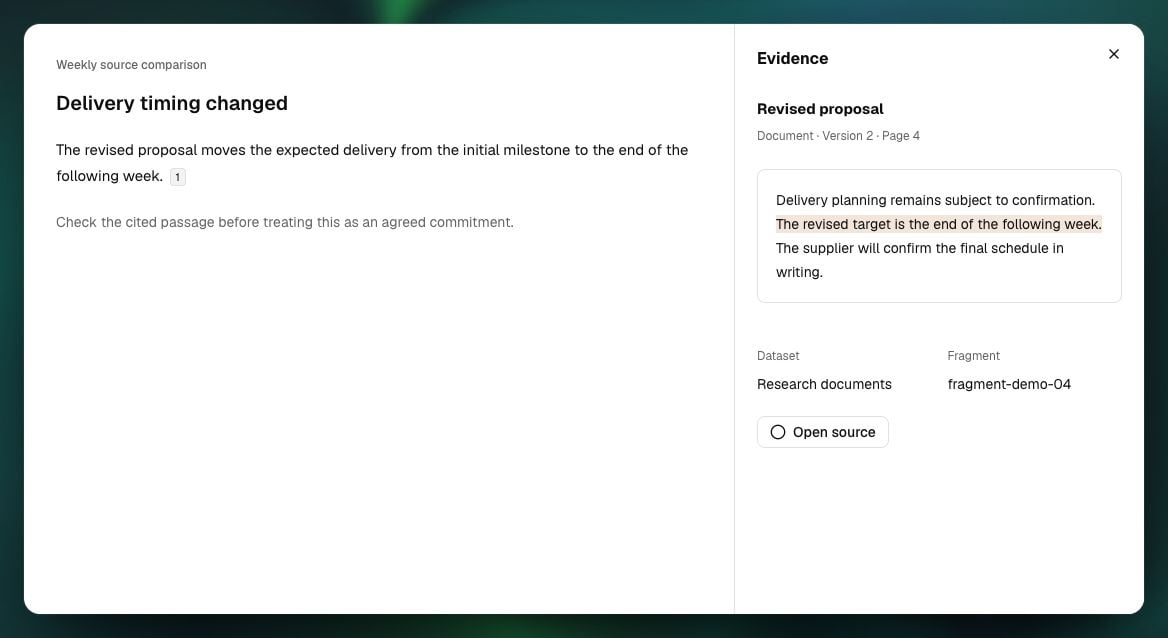
Illustrative finding and source inspector: follow the citation to the exact source version and passage. The documents are invented examples.