

Meet Kato

- “Create a workspace for our Bristol transport investigation.”
- “Set up an ingestion pipeline for these sources.”
- “Build a workflow that turns the collected material into a weekly brief.”
Open the command palette with Command+K
Press ⌘K on a Mac or Ctrl+K on Windows or Linux. You can also select Search or ask Kato in the top bar. The palette opens on All. Type a destination, an item name, or a command, then select the matching row.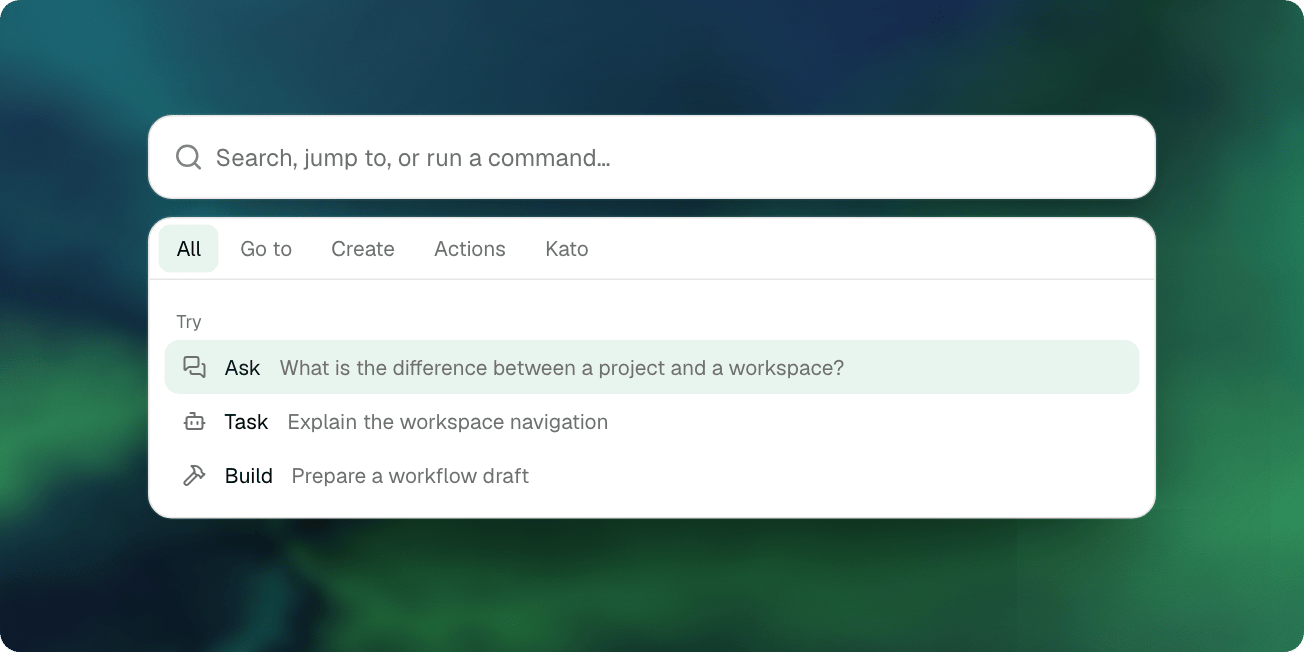
Illustrative command palette: use the search field and tabs to choose between navigation, creation, actions, and a question for Kato. Example suggestions depend on your context and access.
With focus in the search field, Tab moves to the next palette tab and Shift+Tab moves to the previous one. Use the arrow keys to select a row and Enter to activate it. Press ⌘K or Ctrl+K again to close the palette.
In a creation sequence, Backspace in an empty search field returns one step. Outside a sequence, it returns from a filtered tab to All.
Jump to a page or return to earlier work
To open your workspace quickly:- Open the palette and select Go to.
- Type at least two characters of its name, such as
Bristol. - Select the matching workspace.
- Check its name and the page you have opened before continuing.
Ask Kato from the palette
The Kato tab also gives you a route into Kato conversations. Try a product question such as “What is the difference between a project and a workspace?” For natural-language tasks across the platform, see Meet Kato.Start from Home
Choose Home in the section switcher to see an overview of your work. With Vantage access, Your workspaces shows workspace cards and recent agent chats within them. Open a card to enter that workspace, or choose All workspaces for the fuller list. The status filters help you focus on rooms that need attention, are running, or are ready. Since you were last here shows recent activity. An activity item can take you to the resource it concerns. The waiting on you control opens Review; its count is a cue to inspect the waiting work, rather than approval of its outcome. Without Vantage access, Home shows activity without the workspace column. The content and destinations you see depend on your account and permissions.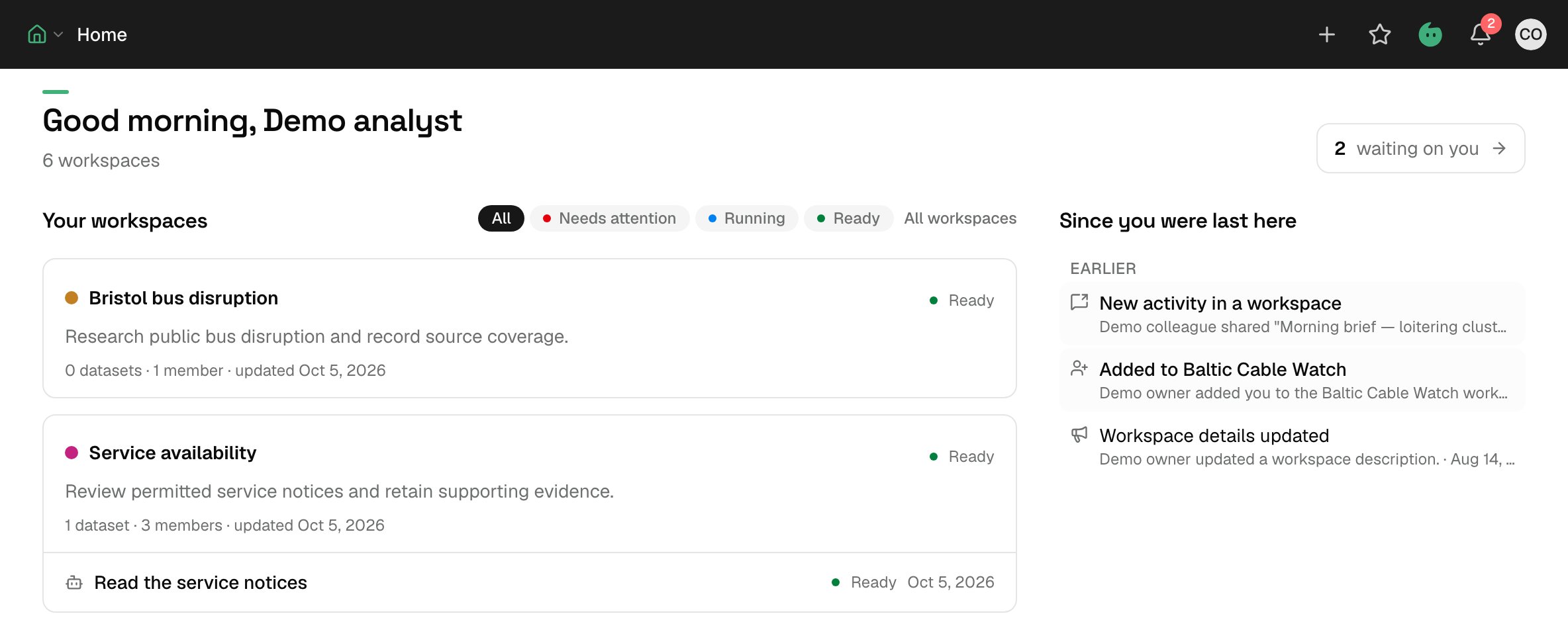
Illustrative Home screen: the section switcher sits at the upper left; workspace cards and recent activity provide routes back into work. Example counts and statuses are not live results.
Use the app spindle to switch sections
The app spindle is the section switcher at the upper left. Its control is labelled Switch section and shows the current section’s name and icon. On a page with a sidebar, look at the top of that sidebar; on an overview screen, look in the top bar. Open it and choose a destination:
Additional destinations, such as Console or Compliance, appear for the relevant roles. A visible destination does not grant access to every resource inside it.
Switching sections changes where you are working. It does not move chat context, project files, or datasets between Arc and Vantage. See What carries over for those boundaries.
Use the sidebar and breadcrumbs within a section
The sidebar gives you the destinations relevant to your current section. Overview screens can appear without a sidebar; opening a chat or workspace brings in its more detailed navigation. In Chats, use New chat, Projects, and Artefacts, or return to a recent conversation. Inside a Vantage workspace, first check the workspace name. Then use:- Summary for its goal and details.
- Explore for workspace agent chats and investigations.
- Collections and Datasets for its organised data.
- Workflow runs and Apps for structured work.
- Access and Settings for the operations your permissions allow.
Recognise the shared controls
The top bar also gives you:- Create for available creation actions.
- Starred for resources you have marked for quick return.
- The notification bell for activity and notifications.
- Your account menu for account controls.