Use collections to organise the datasets a workspace can select. One collection can group several datasets, and the same dataset can appear in several collections or workspaces without being copied.

Before you change a collection

You need access to the workspace and the permissions required for the collection and dataset operation. Collection Owners manage the collection; workspace membership alone is not a general right to change every dataset. Check your clearance, the dataset’s highest applicable label, and the security level of every workspace that will reach it. If you are unsure who can authorise the change, ask the relevant collection or dataset Owner.

Know what you are organising

A dataset can exist outside a collection. Workspace analysis can select it only after it belongs to at least one collection that the workspace reaches. Direct dataset attachment without a collection is unavailable.

1. Choose a grouping that serves the goal

Start from the workspace brief. In the Bristol bus disruption example, a collection called Service disruption could group prepared operator-alert and roadworks datasets. These are illustrative groupings, not a promise of available connectors or ingested transport data. Include only datasets whose access and coverage have been checked. Create a collection in the workspace, or use an existing collection you are permitted to manage. A useful collection name tells another analyst why its datasets belong together.
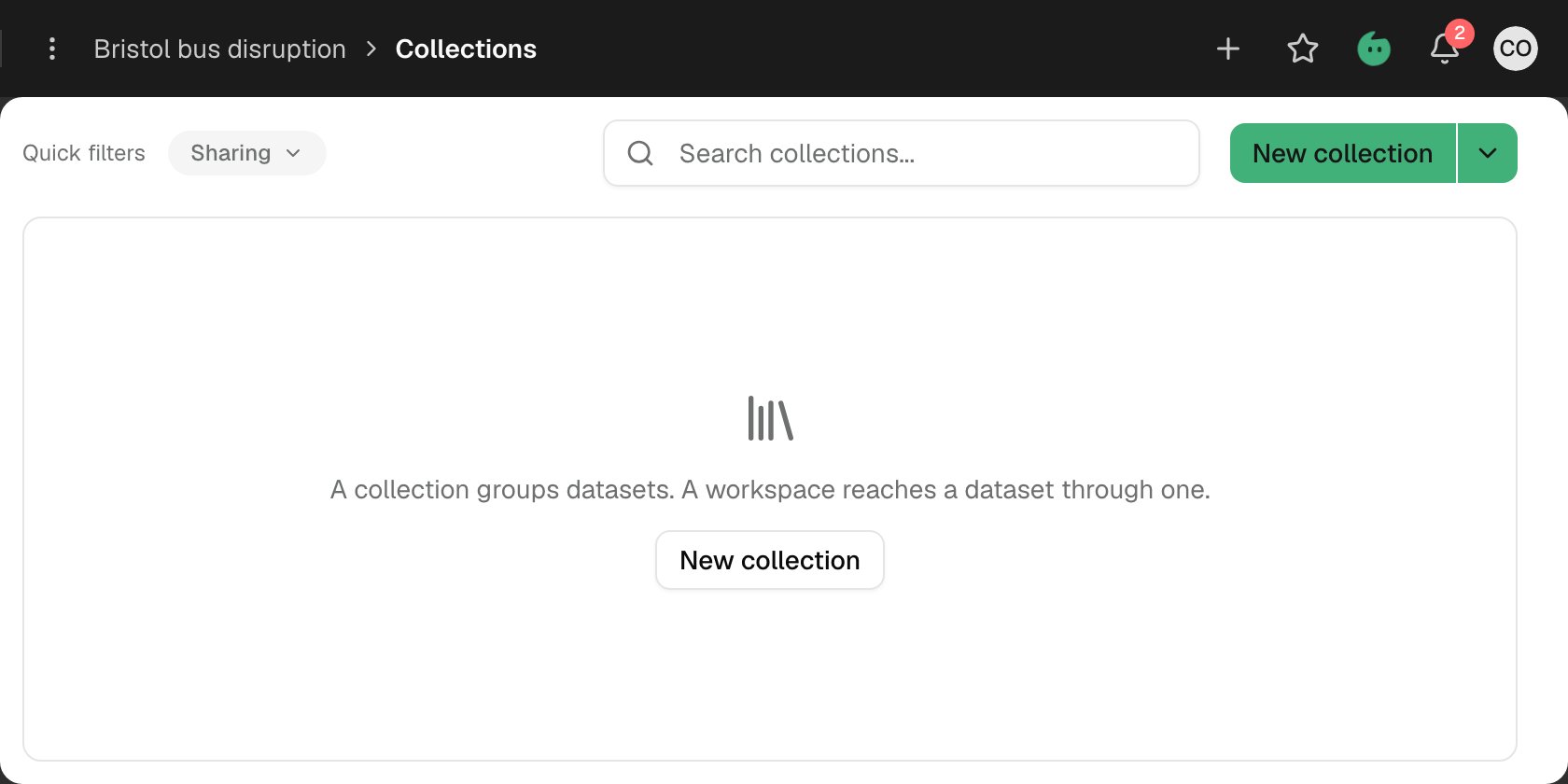
Illustrative Bristol bus disruption Collections page with an empty list and New collection controls.

Illustrative empty collection list: the workspace has no grouped datasets yet. An empty list is a setup state, not evidence that no disruption occurred.

2. Add the permitted datasets

Before adding a dataset, check its identity, source coverage, relevant period, and processing state. Confirm that it belongs in the collection and that the destination audience is permitted to receive it. Adding a dataset normally requires permission to share it. There is a narrower exception: read permission can suffice when a non-reusable collection in the same home workspace already holds the dataset. Collection and destination permissions still apply. Your clearance must cover the dataset, and every workspace that reaches the collection must have a security level at or above the dataset’s highest applicable label. A dataset’s highest label includes its files and its dataset security ceiling. After saving membership, check that the dataset is selectable in the intended workspace. If authorisation repair is pending, protected access is refused until it completes. Treat that as an access state, not an empty analytical result.

3. Check what attachment grants

Once a workspace reaches a dataset through a collection, its members receive Reader access to that dataset, subject to clearance and current checks. That attachment does not give them dataset write authority. Even a workspace Owner needs the applicable grant on the dataset to update it, ingest into it, or manage its permissions. Dataset Contributor authority is required for ingestion and ingestion-job execution. Sharing a dataset does not automatically share its source connection, scripts, or credentials. An ingestion job keeps its own source, credential scope, and billing owner when collection membership changes. Enrichment results also depend on their binding scope and clearance.

Reuse a dataset or a collection

Adding the same dataset to another workspace’s collection preserves its identity and evidence history. If several collections include it, workspace-wide selection includes it once unless distinct selections are explicitly requested. A reusable collection can be attached to other workspaces. Making it reusable requires permission to share every dataset it contains. Attaching it requires clearance for all of those datasets and a destination security level that accommodates them. Collections are attached or detached rather than moved. Attaching or detaching a collection changes authorisation for all of its datasets together, so check the full membership before making that change. Reuse and duplication have different results: duplication creates a new dataset identity, while adding collection membership keeps the existing one.

Remove membership without losing the distinction

When a dataset no longer serves a collection’s purpose, remove the appropriate membership through an authorised operation. Removing its last membership in a workspace removes it from new workspace selections. This does not delete the dataset or evidence retained by earlier work. A dataset that still belongs to another collection reached by that workspace remains attached. Retained evidence continues to require current access. Removing membership is not permission to retrieve historical content after a grant has been revoked.

Check the result

You should be able to identify which datasets each collection contains, why they belong there, and which workspaces reach them. Check that the relevant dataset is selectable once, that its coverage limits remain understood, and that users have the authority needed for their next operation. Next, check Manage workspace members and security level, or return to Create a workspace around a goal.